Modern organizations depend on software for nearly every part of their operations. Websites, cloud applications, mobile apps, APIs, and internal business systems all process data and provide services that attackers may try to disrupt or exploit.
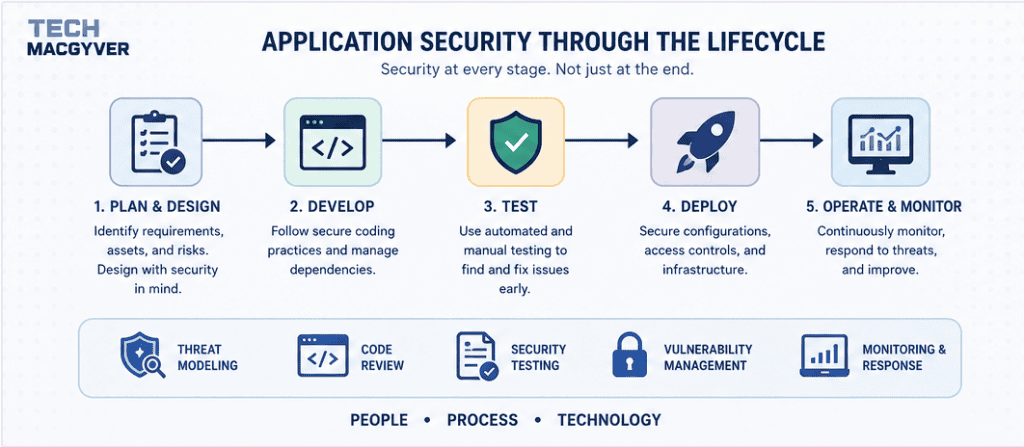
Application security, often called AppSec, is the practice of protecting software from security threats throughout its entire lifecycle. It begins during planning and design, continues through development and testing, and remains important after an application is deployed.
AppSec is not limited to running a vulnerability scanner shortly before launch. It includes secure design, safe coding practices, security testing, risk assessment, monitoring, vulnerability management, and ongoing maintenance.
Why Application Security Matters
Applications often handle sensitive information such as customer records, passwords, payment details, health information, and proprietary business data. A weakness in an application can allow an attacker to steal information, take over accounts, interrupt services, or gain access to connected systems.
Application environments have also become more complex. A single business application may depend on cloud services, third-party libraries, APIs, containers, databases, and external identity providers. Each component introduces potential security risks.
A strong AppSec program helps organizations identify those risks before attackers exploit them.
Core Application Security Principles
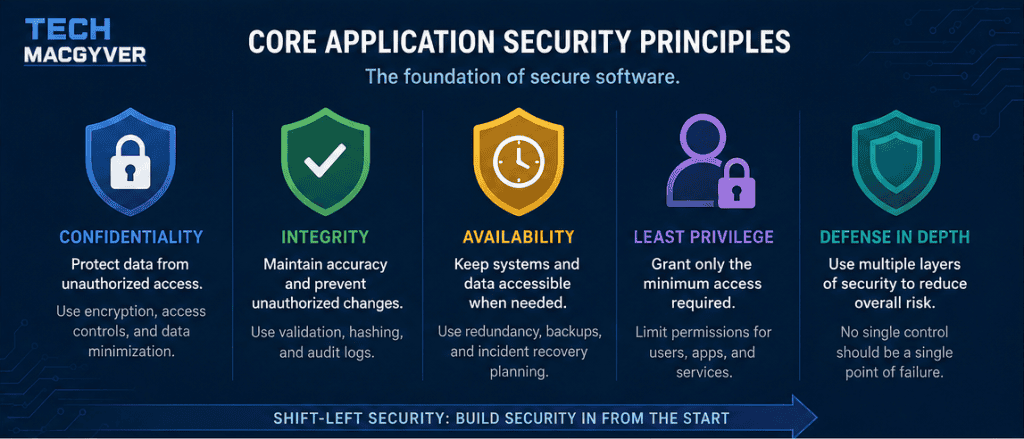
Several basic security principles form the foundation of application security.
Confidentiality
Confidentiality means protecting information from unauthorized access or disclosure. Applications should restrict access to sensitive data based on a user’s identity, role, and business need.
Common controls include:
- Encryption for stored and transmitted data
- Access controls
- Strong authentication
- Data masking
- Secrets management
- Data classification
Applications should also avoid collecting or storing more sensitive data than necessary.
Integrity
Integrity means protecting data and systems from unauthorized changes. Users and organizations must be able to trust that information has not been altered improperly.
Integrity controls may include digital signatures, hashing, audit logs, database controls, version tracking, and approval workflows.
Availability
Availability means keeping applications and data accessible when authorized users need them. Security incidents, infrastructure failures, and software errors can all disrupt availability.
Organizations may use redundancy, backups, load balancing, disaster recovery plans, monitoring, and denial-of-service protection to reduce downtime.
Least Privilege
Least privilege means giving users, applications, and services only the permissions required to perform their assigned functions.
For example, an application service should not have full administrative rights to a database when it only needs permission to read a limited set of records.
Limiting privileges helps reduce the damage caused by compromised accounts, software flaws, and configuration mistakes.
Defense in Depth
No single control can prevent every attack. Defense in depth uses multiple layers of protection so that one failed control does not automatically lead to a major breach.
An application might use secure coding, network filtering, access controls, logging, encryption, monitoring, and endpoint protection together.
Shift-Left Security
Shift-left security means addressing security earlier in the software development lifecycle.
Instead of waiting until an application is nearly complete, teams consider security during requirements gathering, architecture, design, coding, and testing. Finding a design flaw early is usually easier and less expensive than fixing it after deployment.
Secure Coding Practices
Secure coding is the practice of writing software that resists common attacks and handles errors safely.
Validate Input
Applications should treat all external input as untrusted. This includes user entries, uploaded files, API requests, cookies, database content, and information received from other systems.
Input validation should check expected type, length, format, range, and allowed values. Allow-list validation is generally safer than trying to identify every possible malicious value.
Developers should also use parameterized queries or prepared statements to reduce the risk of SQL injection.
Encode Output
Data displayed in a browser or other interface should be encoded for the specific output context.
Encoding requirements differ depending on whether data appears in HTML, JavaScript, CSS, a URL, or an HTML attribute. Proper output encoding helps prevent cross-site scripting attacks.
Protect Authentication and Sessions
Authentication confirms who a user is. Session management maintains that identity while the user interacts with the application.
Applications should support strong passwords, multifactor authentication where appropriate, secure password storage, session expiration, account lockout controls, and secure cookies.
Passwords should never be stored in plain text.
Enforce Authorization
Authorization determines what an authenticated user is allowed to do.
Authorization checks should occur on the server side for every sensitive action. Applications should not rely on hidden buttons, client-side controls, or URL structure to prevent access.
Developers must also protect against object-level authorization flaws, where users can access records belonging to someone else by changing an identifier.
Handle Errors Safely
Applications should provide users with enough information to understand that an error occurred without exposing sensitive technical details.
Detailed stack traces, database errors, internal file paths, and configuration information should be recorded in protected logs rather than displayed publicly.
Manage Secrets Properly
Passwords, API keys, certificates, encryption keys, and access tokens should not be hard-coded into source code or stored in public repositories.
Organizations should use a secure secrets-management system and rotate secrets when necessary.
Secure Third-Party Components
Most modern applications depend on open-source libraries, frameworks, and commercial software packages.
Organizations should maintain an inventory of these components, monitor them for known vulnerabilities, and apply updates based on risk. A Software Bill of Materials, or SBOM, can help document which software components are included in an application.
However, an SBOM alone does not fix vulnerabilities. It must be supported by vulnerability scanning, review, prioritization, and patch management.
Build Security Into APIs
APIs should use strong authentication, encrypted communications, input validation, authorization checks, rate limiting, and secure token handling.
Teams should also maintain an accurate inventory of APIs and remove or disable outdated endpoints.
Application Risk Assessments
An application risk assessment identifies threats, weaknesses, potential business impact, and the controls available to reduce risk.
A complete assessment should consider:
- The purpose of the application
- The data it stores or processes
- The users and systems that can access it
- Potential attackers and attack methods
- Known vulnerabilities
- Business and operational impact
- Existing security controls
- Likelihood of exploitation
- Residual risk after controls are applied
Risk assessments help organizations decide which issues require immediate action and which can be accepted, transferred, avoided, or addressed later.
Common AppSec Assessment Methods
Several security activities provide information that supports risk decisions.
Threat Modeling
Threat modeling examines how an attacker might target an application before or during development.
Teams identify important assets, trust boundaries, data flows, entry points, and possible misuse cases. They then design controls to reduce the most serious risks.
Static Application Security Testing
Static application security testing, or SAST, examines source code or compiled code without running the application. It can identify insecure coding patterns, injection risks, weak cryptography, and other flaws.
Dynamic Application Security Testing
Dynamic application security testing, or DAST, examines a running application from the outside. It tests how the application responds to potentially malicious requests.
Software Composition Analysis
Software composition analysis identifies third-party and open-source components and compares them with known vulnerability information.
Penetration Testing
Penetration testing simulates real-world attacks to determine whether vulnerabilities can be exploited.
It is useful for finding issues that automated tools may miss, especially those involving business logic, authorization, chained weaknesses, and application-specific behavior.
Code Review
Manual security code review can identify subtle problems that automated tools do not fully understand. It is particularly useful for authentication, authorization, cryptography, session handling, and sensitive business logic.
Monitoring and Vulnerability Management
AppSec continues after deployment.
Applications should generate useful security logs for events such as failed logins, privilege changes, administrative actions, access to sensitive records, and unusual API activity.
These logs may be sent to a security information and event management platform, or SIEM, for correlation and alerting.
Organizations also need a process for receiving vulnerability reports, assigning ownership, setting remediation deadlines, verifying fixes, and documenting accepted risks.
Important AppSec Frameworks and Standards
Several recognized resources can help organizations build application security programs.
OWASP Top 10
The OWASP Top 10 is an awareness document that describes common categories of web application security risk.
It is useful for education and prioritization, but it is not a complete security standard or testing checklist.
OWASP Application Security Verification Standard
The OWASP Application Security Verification Standard, or ASVS, provides detailed and testable application security requirements.
Organizations can use it to define security expectations, guide development, and evaluate application controls.
OWASP API Security Top 10
The OWASP API Security Top 10 focuses on common risks in APIs, including broken authorization, weak authentication, resource abuse, and poor API inventory management.
NIST Secure Software Development Framework
The NIST Secure Software Development Framework, also known as SSDF or NIST SP 800-218, provides practices for integrating security into software development.
It covers preparation, software protection, secure development, and vulnerability response.
OWASP Software Assurance Maturity Model
The OWASP Software Assurance Maturity Model, or SAMM, helps organizations evaluate and improve the maturity of their software security programs.
Common Weakness Enumeration
The Common Weakness Enumeration, or CWE, provides a standardized list of software weakness types. It helps developers, testers, and security teams use consistent language when discussing vulnerabilities.
Building an Effective AppSec Program
An effective AppSec program combines people, processes, and technology.
Security teams cannot secure applications alone. Developers, architects, system administrators, product managers, testers, and business leaders all have a role.
Organizations should begin by identifying their most important applications and data, establishing basic secure development standards, and assigning clear responsibility for security issues.
From there, they can gradually add threat modeling, automated testing, secure code review, dependency management, penetration testing, and continuous monitoring.
The goal is not to eliminate every possible risk. That is rarely realistic. The goal is to understand application risk, reduce it to an acceptable level, and respond quickly when new weaknesses are discovered.
Application security works best when it is treated as a continuous part of software development and operations rather than a final checklist completed before release.