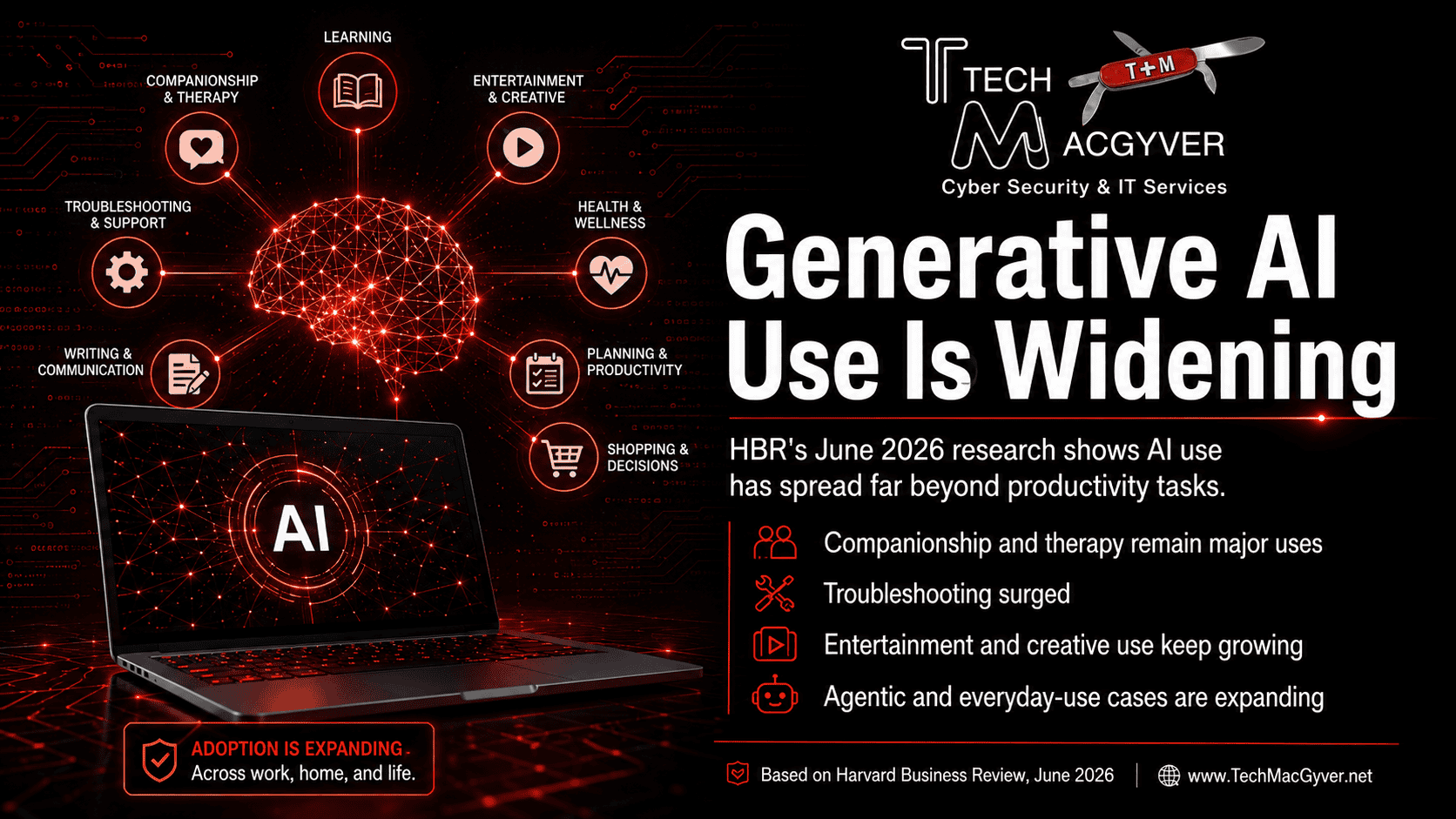
In the June 1, 2026 Harvard Business Review article “How People Are Really Using AI in 2026,” Marc Zao-Sanders shares the third edition of his “AI in the Wild” research, which looks at how people are actually using generative AI in everyday life. The big takeaway is that AI use has spread far beyond the early focus on workplace writing, coding, learning, and productivity. People are now turning to AI for a much wider mix of tasks, including emotional support, entertainment, technical help, daily problem-solving, and more agent-like activities. HBR describes this as an “ever-widening range of uses” and notes that the annual rankings should be seen as snapshots of changing behavior, not permanent conclusions about what AI is best for. (Harvard Business Review)
The article also places the 2026 findings in the larger story of AI’s rapid growth since ChatGPT broke through in late 2022. HBR points to several signs of scale: the rise of “vibe coding,” more companies experimenting with agentic workflows, ChatGPT reportedly reaching 900 million regular users, Gemini passing 750 million, and OpenAI hitting an $852 billion valuation in a funding round. The exact numbers matter less than what they signal. Generative AI is no longer a niche productivity tool. It has become a mainstream technology that people use for work, entertainment, reflection, advice, troubleshooting, and even companionship. (Harvard Business Review)
One of the clearest themes is the continued importance of personal and emotional use. “Therapy/companionship” remained the top use case in 2026, just as it was in 2025, according to social posts discussing HBR’s published chart. That is significant because it challenges the usual business-focused view of AI as mainly a tool for productivity, automation, or efficiency. Many users seem to value AI not only for the content it produces, but also because it is always available, responsive, conversational, and nonjudgmental. At the same time, this raises serious questions about emotional dependency, loneliness, mental-health boundaries, and whether AI should ever be treated as a substitute for human support. (LinkedIn)
The rankings also point to a stronger role for practical help and entertainment. “Troubleshooting” reportedly rose to second place, while “fun and nonsense” reached third. “Fan fiction and storytelling” also moved into the top tier, showing that many people are using AI as a casual creative partner for recreational writing, fandom, and play. These examples suggest that AI adoption is not being shaped only by companies and formal enterprise strategies. Ordinary users are experimenting with AI in personal, messy, and sometimes playful ways, and those uses are becoming a major part of the technology’s growth. (X, formerly Twitter)
Another notable shift is the rise of more technical and agentic uses. HBR’s public page notes that companies have increasingly adopted agentic workflows, and outside discussion of the HBR chart identifies “autonomous agentic operations” as a new top-ten use case. This suggests that AI use is moving beyond simple chatbot interactions. People and organizations are beginning to use AI for multi-step tasks, tool use, and more active forms of assistance. At the same time, some earlier headline uses, such as idea generation, enhanced learning, organizing life, and creativity, appear to have dropped in relative ranking. (Harvard Business Review)
The practical lesson for organizations is that AI adoption should not be defined too narrowly. Leaders who focus only on cost savings, document drafting, coding support, or back-office automation may miss the ways people are already building AI into their daily habits. The real adoption story is broader. AI is becoming a general-purpose assistant for uncertainty, emotion, entertainment, diagnosis, planning, and small decisions. For businesses, that means training and governance need to address everyday uses, not just official workflows. For product teams, it means users may care about companionship, responsiveness, and task completion just as much as accuracy or speed.
The caution is just as important. Broader use does not automatically mean better use. Some fast-growing categories, including relationship advice and astrology or tarot readings, suggest that people may turn to AI when they are lonely, vulnerable, confused, or looking for reassurance. That brings risks around overtrust, bad advice, privacy exposure, and emotional manipulation. The article’s main value is that it shifts the AI conversation away from abstract hype and toward real behavior: what people are actually doing with these tools, where habits are forming, and where the next business, ethical, and social questions are likely to appear.